

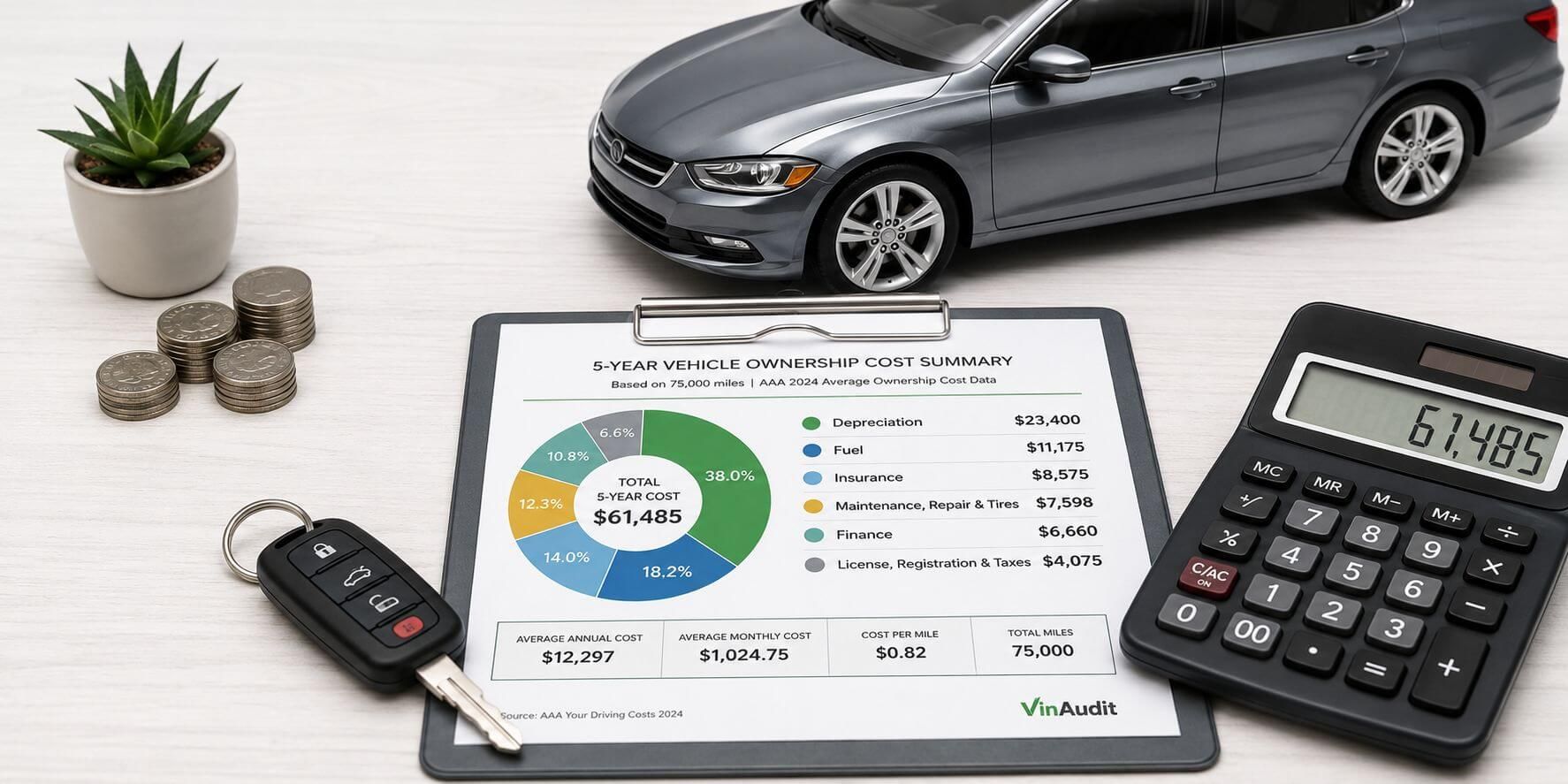
Sticker price is only the beginning of what a vehicle really costs.
A car that looks affordable on day one can become expensive over five years once you account for depreciation, insurance, fuel, maintenance, financing, taxes, registration, and repairs. That is why more automotive platforms, lenders, dealers, marketplaces, and fleet tools are moving beyond static pricing and turning to ownership-cost models that show the bigger financial picture.
A car ownership cost API helps solve that problem by turning raw vehicle data into a more complete cost-of-ownership estimate. Instead of showing only MSRP, list price, or a monthly payment, an ownership-cost API can help businesses estimate what a vehicle may cost to own over a five-year period based on its class, fuel type, usage assumptions, and ongoing expenses.
This matters because buyers are no longer comparing vehicles on price alone. They are comparing total value.
What Is a 5-Year Vehicle Ownership Cost?
A five-year vehicle ownership cost is an estimate of what it takes to buy, operate, and keep a vehicle over a typical ownership window.
Instead of focusing on one number, it combines several cost categories into a broader picture of affordability. Depending on the platform or model, those categories may include:
- depreciation
- financing or loan-related cost
- insurance
- fuel or charging
- maintenance
- repairs
- tires
- taxes, title, registration, and fees
This type of model is useful because two vehicles with similar purchase prices can have very different long-term costs. A lower-priced vehicle may lose value faster, cost more to insure, or require more maintenance. A more expensive model may hold resale value better and produce a lower net cost over time.
Why Sticker Price Is Not Enough
A vehicle listing page that shows only price leaves out the costs that shape ownership decisions after the sale.
For example:
- a buyer may focus on a low list price but overlook high insurance premiums
- a lender may evaluate payment affordability without seeing likely long-term operating burden
- a dealership may promote a vehicle’s purchase price without showing how it compares on five-year value
- a marketplace may rank listings by price alone even when total ownership cost tells a different story
That is why five-year cost visibility has become more important across automotive technology. It helps turn vehicle search and pricing into a more realistic comparison.
The Main Cost Buckets in a 5-Year Ownership Model
A strong car ownership cost API should break total ownership into components rather than returning a single black-box number.
1. Depreciation
Depreciation is often the biggest ownership cost over time. It measures how much value a vehicle is expected to lose between acquisition and resale.
This category matters because two models with similar MSRPs can behave very differently in the used market. Vehicles with stronger demand, better brand reputation, or more stable resale value can outperform cheaper vehicles that lose value quickly.
2. Insurance
Insurance can materially change five-year affordability, especially for newer vehicles, high-theft models, luxury trims, performance variants, and vehicles in higher-cost regions.
For many consumers, insurance is one of the least visible costs during shopping, even though it can significantly change the total ownership picture.
3. Fuel or Energy Cost
Fuel cost varies by powertrain, mileage assumptions, driving mix, and local energy prices. A five-year model should account for this because a fuel-efficient hybrid, EV, or compact gas vehicle can look very different from a truck or performance SUV once operating cost is projected across years of use.
4. Maintenance and Repairs
Routine service and wear items may appear manageable month to month, but they add up over time. Some vehicles also bring higher out-of-warranty repair exposure, which becomes relevant in longer ownership windows.
5. Taxes, Fees, and Registration
Title fees, annual registration, and state-level taxes can materially affect total cost, especially when the platform serves users across multiple jurisdictions.
6. Financing Cost
A buyer’s interest rate and loan structure influence affordability well beyond the sale price. A vehicle may be competitively priced but still generate a higher five-year burden if financing terms are less favorable.
Why an API Matters More Than a Static Calculator
A static calculator can be useful for one-off estimates, but it is limited when a business needs ownership cost data at scale.
A car ownership cost API is more useful when the goal is to power:
- vehicle listing pages
- dealership inventory tools
- lender or prequalification flows
- comparison engines
- appraisal systems
- consumer research platforms
- fleet acquisition dashboards
With an API, ownership-cost estimates can be calculated dynamically and tied to the actual vehicle being viewed. That makes the experience more relevant, more scalable, and easier to integrate into automotive workflows.
What a Car Ownership Cost API Can Power
Ownership-cost data becomes more powerful when it is embedded directly into product experiences.
Vehicle comparison tools
Buyers comparing two similar models often need more than price and mileage. Showing estimated five-year cost helps explain why one vehicle may be the stronger value.
Dealer inventory pages
Dealers can use cost-of-ownership insights to frame value more clearly, especially when a vehicle has stronger long-term economics than its sticker price suggests.
Marketplace sorting and ranking
A marketplace can go beyond simple price sorting by highlighting vehicles with better total-cost profiles.
Lender and fintech tools
Lenders and finance platforms can use ownership-cost estimates to support affordability logic, prequalification flows, and more realistic payment discussions.
Fleet and procurement workflows
Fleet operators care deeply about multi-year cost visibility. A structured ownership-cost feed can help compare acquisition options using long-term economics rather than purchase price alone.
What to Look for in a Car Ownership Cost API
Not all cost APIs are equally useful. A strong solution should offer more than a simple estimate.
Here are the features that matter most:
- VIN-based or vehicle-specific input support
- structured cost categories instead of one flat total
- support for five-year ownership modeling
- logic that can work across trims, body styles, and fuel types
- integration-friendly output for websites, dashboards, and apps
- consistent methodology that can scale across many vehicles
The more transparent the data model is, the easier it becomes for businesses to explain cost results to users and apply them across different automotive use cases.
Why VIN-Level Data Improves Cost Modeling
Ownership cost becomes more accurate when it is tied to the actual vehicle rather than a generic category.
That is where VIN-based data matters. Vehicle attributes such as model year, trim, engine type, drivetrain, and body style all affect long-term cost. A generic midsize SUV estimate may be directionally helpful, but a VIN-level model is much more useful when the goal is operational accuracy.
This is why ownership-cost tools often work best when paired with broader automotive data infrastructure. For example, VinAudit vehicle data products can help businesses connect vehicle identity, specifications, and related signals into a more complete automotive data workflow.
For platforms that need technical implementation, vehicle data APIs can support integrations where ownership cost becomes one layer of a larger pricing, comparison, or research experience.
A Simple Example of How 5-Year Cost Changes the Decision
Imagine two vehicles with similar asking prices.
One has weaker resale retention, higher insurance cost, and worse fuel economy. The other costs slightly more upfront but holds value better and costs less to operate.
If the platform only shows purchase price, the cheaper vehicle may look like the better deal. If the platform shows estimated five-year ownership cost, the more efficient and better-retaining vehicle may actually present the stronger long-term value.
That is the core benefit of ownership-cost APIs. They help users compare vehicles more intelligently.
Who Benefits Most From a Car Ownership Cost API?
A five-year ownership cost API is especially useful for:
- dealerships that want to present value more clearly
- automotive marketplaces that want better comparison tools
- lenders and fintech platforms focused on affordability
- fleet and procurement teams comparing long-term cost
- research tools that want to go beyond basic pricing data
- consumer platforms helping users choose between models
In every case, the goal is the same: move from shallow price comparison to deeper cost understanding.
Conclusion
Five-year vehicle cost is one of the most useful ways to understand what a car really costs beyond the window sticker.
Depreciation, insurance, fuel, maintenance, taxes, fees, and financing all shape the total ownership picture. A car ownership cost API helps businesses organize those moving parts into a structured, scalable data product that can power comparison tools, listing pages, lending workflows, and automotive decision engines.
For automotive businesses, this is more than a data feature. It is a better way to explain value.
Frequently Asked Questions
What is a car ownership cost API?
A car ownership cost API is a data service that helps estimate what a vehicle may cost to own over time, often by breaking total ownership into categories such as depreciation, insurance, fuel, maintenance, and fees.
Why use a five-year vehicle cost model?
A five-year model gives a more realistic view of affordability than purchase price alone because it reflects the longer-term costs of keeping and operating the vehicle.
What costs are usually included in a five-year ownership estimate?
Common categories include depreciation, financing, insurance, fuel or charging, maintenance, repairs, tires, and taxes or registration fees.
Who uses ownership cost APIs?
Ownership cost APIs are useful for dealerships, marketplaces, lenders, fleet tools, automotive software platforms, and consumer research experiences.
Why is VIN-level data important for ownership cost?
VIN-level data improves accuracy by tying the estimate to the actual vehicle’s year, trim, engine, drivetrain, and other specifications rather than relying on a generic class estimate.