

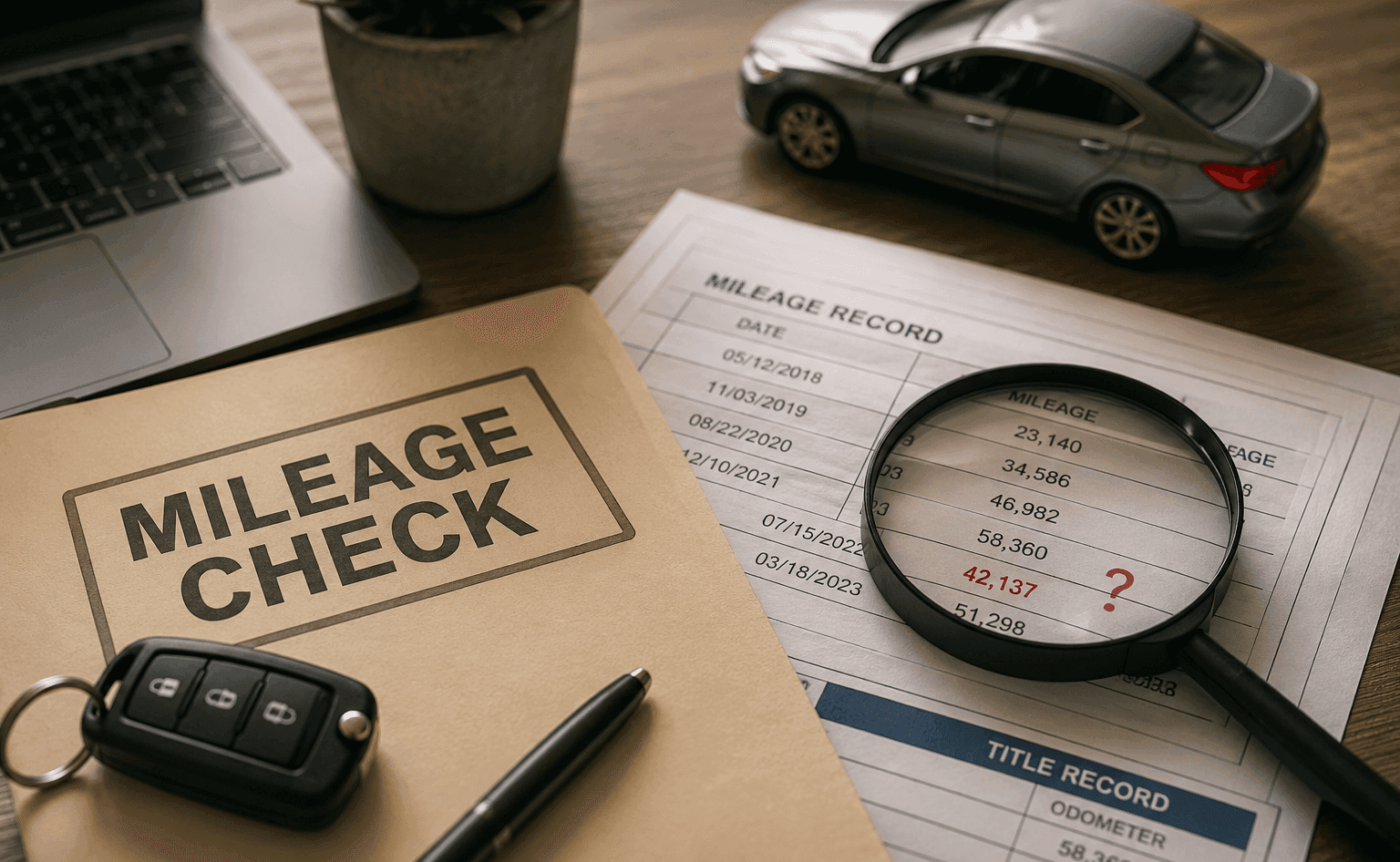
Odometer rollback is one of the oldest used-car scams, and it still matters because mileage has a direct effect on price.
A car with fewer miles usually looks more valuable. That creates an obvious temptation for dishonest sellers to make the vehicle appear less used than it really is. The problem is that a rolled-back odometer can trick buyers into overpaying, misjudge maintenance needs, and take on more wear and risk than they expected.
The good news is that odometer fraud often leaves clues. The number on the dashboard is only one part of the story. Vehicle records, service history, title entries, inspection documents, and even the car’s physical wear can help you spot mileage that does not make sense.
This guide explains how to check for odometer rollback using vehicle records and service clues, what red flags matter most, and how to use those clues before buying a used car.
Quick Answer
To check for odometer rollback, compare the vehicle’s displayed mileage against:
- title and registration records
- service and maintenance records
- inspection or emissions records when available
- vehicle history report mileage entries
- physical wear on the car
- the seller’s story about how the car was used
The biggest warning sign is not just one odd number. It is a pattern that does not make sense when all the records are viewed together.
Why Odometer Rollback Matters
Mileage affects value, maintenance timing, and buyer confidence.
If a seller rolls back the odometer, the vehicle may appear newer, cleaner, and more lightly used than it really is. That can distort the asking price and hide how close the car may be to major maintenance or repairs.
A used car with fake low mileage is not just overpriced. It can also be riskier to own because the buyer may underestimate wear on the engine, transmission, suspension, brakes, and other components.
Start With the Dashboard Mileage — Then Question It
The odometer reading is the starting point, not the final answer.
When you see the mileage, ask yourself whether it fits the car’s age and overall condition. Low mileage can be real, but it should make sense in context. A very old car with unusually low miles may still be legitimate, but it deserves more verification, not less.
The important mistake to avoid is assuming the number is accurate just because it is displayed neatly on the dashboard.
1. Check the Vehicle History Report for Mileage Patterns
One of the fastest ways to screen for mileage problems is to review the recorded mileage history over time.
A VIN check can help you look for mileage entries tied to title events, registration activity, inspections, service records, or other reporting points. What you want is a pattern that moves forward in a believable way.
Watch for these red flags:
- mileage that moves backward
- a later record that shows fewer miles than an earlier one
- unusual jumps that do not fit the vehicle’s age
- long gaps followed by suspiciously low entries
- a current odometer reading that does not fit the recorded history
A single odd entry may sometimes be a data-entry mistake. Several inconsistent entries are much harder to dismiss.
2. Review Title Records Carefully
Title history is one of the most important sources for mileage clues.
Mileage is often recorded during title transfers, which makes title records especially useful when you are trying to see whether the vehicle’s mileage has changed in a believable way over time. If the title records show a higher number in the past than what the dashboard shows today, that is an immediate red flag.
You should also be cautious if the seller cannot clearly explain title gaps, delayed title transfers, or title activity that does not match the ownership story.
3. Compare the Mileage With Service Records
Service records are one of the best real-world checks against odometer fraud.
Ask the seller for receipts or maintenance paperwork. Oil changes, brake service, battery replacement, tire work, and other routine maintenance often include mileage at the time of service. Compare those entries with the current odometer reading.
Red flags include:
- service invoices showing higher mileage than the current odometer
- the seller claiming low mileage but having no records to support it
- maintenance timing that does not fit the claimed miles
For example, if a vehicle supposedly has very low mileage but already has records that suggest major wear-item replacement at a much higher usage level, that deserves more scrutiny.
4. Check Inspection or Emissions Records When Available
In some states or localities, safety inspections or emissions testing may include recorded mileage.
If those documents are available, compare them against the current reading and the vehicle history report. These records can be especially useful because they often come from separate reporting points outside the seller’s control.
Even one old inspection document can help confirm whether the mileage path makes sense.
5. Compare the Mileage With the Car’s Physical Wear
The condition of the car should support the mileage story.
Look closely at:
- driver’s seat wear
- steering wheel wear
- pedal wear
- shifter or control wear
- door handle use marks
- carpet wear
- worn buttons or switchgear
A car with very low claimed mileage should not usually look heavily used inside unless there is a clear explanation. Heavy wear does not prove fraud by itself, but when it conflicts with the odometer reading, it becomes an important clue.
6. Look at the Tires and Other Wear Items
Tires can be a useful clue when checking mileage consistency.
A car with extremely low claimed mileage may still have its original or relatively early-life tires, depending on age and usage. If the car is presented as very low-mileage but has replacement wear items in a pattern that suggests much heavier use, ask why.
You should also look at brake wear, suspension feel, and overall mechanical age. The car’s condition should make sense alongside the number on the dashboard.
7. Listen Carefully to the Seller’s Usage Story
Ask the seller how the car was used.
A believable mileage story usually sounds simple and consistent. Maybe the car was a second vehicle, maybe it was driven locally, or maybe it was owned by someone who used it very lightly. Those explanations can be true.
What matters is whether the story matches:
- the records
- the condition of the car
- the age of the vehicle
- the maintenance pattern
If the seller sounds vague, defensive, or keeps changing the explanation, that is a sign to be more cautious.
8. Do Not Treat a Single Clean Entry as Proof
A lot of buyers feel reassured too early.
One service receipt, one title entry, or one apparently normal mileage reading is not enough by itself. The goal is to build a consistent mileage story across multiple sources.
The strongest conclusions usually come when the dashboard reading, vehicle history, title records, service paperwork, and wear clues all point in the same direction.
9. Use the Listing and Plate Details as Early Clues
Sometimes the warning signs begin before you even see the car.
If the listing emphasizes “very low miles” heavily, but the seller is vague about records or slow to provide the VIN, be cautious. If you are starting with the listing and plate details first, a license plate lookup may help you move toward the next stage of vehicle verification before meeting the seller.
Low mileage is often used as a selling hook, so it should make you more careful, not less.
10. Get an Independent Inspection if the Mileage Story Feels Wrong
If the numbers do not line up or the wear seems inconsistent with the claimed mileage, do not guess.
A mechanic may not be able to prove odometer rollback from a quick inspection alone, but they can often tell whether the car’s wear and mechanical condition fit the claimed usage. That can give you a much stronger basis for deciding whether to keep going or walk away.
Common Odometer Rollback Red Flags
Here are some of the clearest warning signs:
- recorded mileage moves backward over time
- current odometer is lower than older title or service entries
- seller refuses to provide the VIN early
- low mileage does not match visible interior wear
- the seller cannot explain missing records or mileage gaps
- service history and usage story do not fit the odometer reading
- the vehicle is priced like a low-mileage example but the background feels inconsistent
Any one of these may deserve more questions. Several together usually mean the deal needs much more caution.
What to Do if You Suspect Rollback
If you suspect odometer rollback, do not rush ahead just because the car is otherwise attractive.
Instead:
- save the listing details and odometer claim
- compare the VIN history, title records, and service records carefully
- ask the seller direct questions
- get a mechanic inspection if needed
- be prepared to walk away if the mileage story does not hold up
A used car is only a good deal if the mileage is believable.
Final Takeaway
The best way to check for odometer rollback is to stop treating the dashboard number as the whole truth.
A believable mileage story should hold together across title records, service clues, vehicle history entries, inspection documents, physical wear, and the seller’s explanation. When those pieces line up, confidence goes up. When they clash, risk goes up.
That is why the smartest buyers verify mileage from multiple angles before deciding what a used car is really worth.
Frequently Asked Questions
How can I tell if an odometer has been rolled back?
Compare the current reading with vehicle history entries, title records, service invoices, inspection records, and the car’s physical wear. Rollback usually shows up as a pattern that does not make sense.
Can a vehicle history report show odometer problems?
Yes. A vehicle history report can help you spot mileage inconsistencies when recorded entries do not move forward in a believable way.
What physical clues can suggest odometer rollback?
Heavy wear on the seats, pedals, steering wheel, controls, and overall interior condition can suggest more use than the odometer claims.
Should I trust very low mileage on an older used car?
Not automatically. It may be real, but it deserves more verification through records and condition checks.
What should I do if the mileage history looks inconsistent?
Ask for more records, question the seller directly, get an independent inspection, and be ready to walk away if the numbers still do not make sense.