

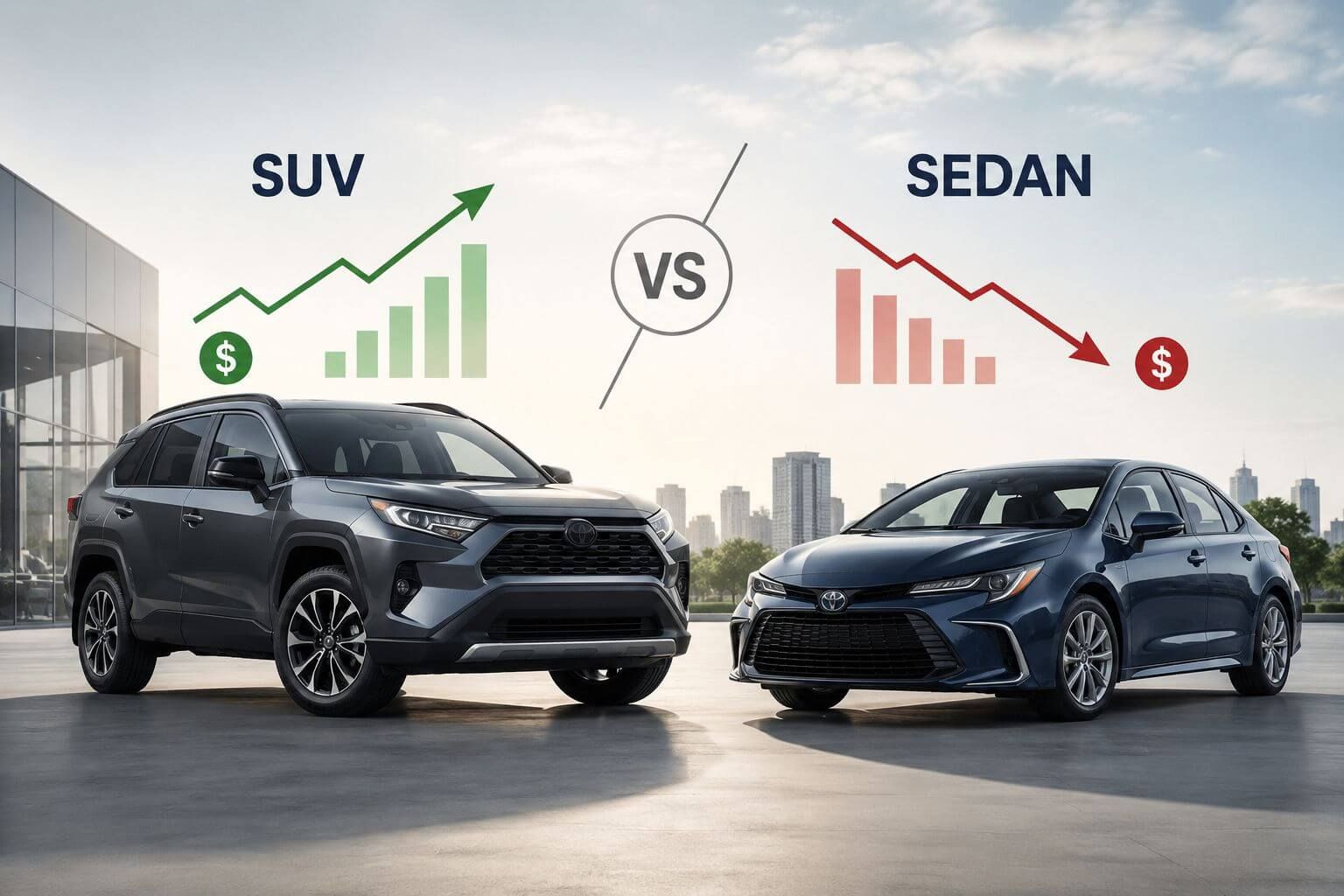
In most parts of the used-car market, yes — used SUV prices are still generally stronger than sedan prices. But the full answer needs more context.
SUVs still benefit from stronger consumer demand, broader family appeal, higher driving position preferences, and a used-inventory mix that has shifted heavily toward crossovers and SUVs over the last several years. That usually gives them better pricing support and stronger resale confidence than comparable sedans. At the same time, sedans are not simply weak across the board. In some market periods, certain sedan segments have held value better than expected, and for many buyers, used sedans now represent better value for the money.
This guide explains whether used SUV prices are still stronger than sedan prices, why that pattern continues, where sedans are holding up better than many people assume, and what the trend means for buyers, sellers, and dealers right now.
Quick Answer
Used SUV prices are still generally stronger than sedan prices because SUVs continue to attract more consumer demand and dominate both new-vehicle production and used-vehicle shopping.
In practical terms:
- SUVs usually command higher asking prices than comparable sedans
- SUVs often hold resale value better because of stronger demand
- Sedans can still perform well in certain segments, especially when affordability matters most
- For buyers, sedans often offer better value even when SUVs remain stronger in market pricing
So yes, SUVs are still stronger overall — but sedans may now offer the smarter bargain in some parts of the market.
Why SUVs Still Hold a Stronger Position
SUVs remain strong because buyer demand has not meaningfully reversed.
For years, the U.S. market has shifted toward trucks, crossovers, and SUVs. That trend started in new vehicles and has steadily changed the used market as those vehicles moved downstream into second-owner inventory. Cars.com reported in January 2026 that sedans, coupes, and convertibles accounted for less than 30% of used inventory, down from 41% in 2019, showing how much the used market has tilted toward utility vehicles. (cars.com)
That matters because demand usually stays stronger when the market gives consumers what they already prefer. SUVs benefit from:
- more cargo space
- easier family use
- higher seating position
- perceived versatility in weather and daily driving
- stronger mainstream appeal across age groups
Those advantages continue to support stronger pricing than many sedan segments.
What the Recent Market Data Suggests
Recent market data supports a more nuanced version of the usual SUV-versus-sedan story.
On the one hand, the broad consumer shift still favors SUVs. Cox Automotive’s industry commentary continues to note that transaction prices stay high in part because of the growing mix of trucks and SUVs versus the shrinking share of cars. (coxautoinc.com) That reflects both buyer preference and the structural change in what gets produced and sold.
On the other hand, monthly and segment-level wholesale trends do not always move in a straight line. For example, Cox Automotive’s October 2024 Manheim update showed SUVs underperforming the market on a year-over-year basis, while midsize sedans outperformed the market in that period. (coxautoinc.com) In November 2024, SUVs showed a stronger month-over-month gain than midsize sedans. (coxautoinc.com)
That tells us something important: SUVs are still stronger overall, but sedan performance can look better than expected during certain pricing cycles.
Stronger Prices Do Not Always Mean Better Value
A higher price is not the same as a better value.
SUVs usually carry stronger prices because more buyers want them. But that same strength can make them more expensive relative to what some shoppers actually need. Sedans often provide better fuel economy, a lower purchase price, and lower replacement cost for buyers who do not need extra cargo space or a higher ride height.
That is why the real question is not just whether SUVs are stronger. It is whether the buyer wants strength in resale or better value at the time of purchase.
Why Sedans Still Matter in the Used Market
Sedans are no longer the dominant choice they once were, but they remain important for affordability-focused buyers.
In a market where affordability is still a major pressure point, sedans can appeal to shoppers who care more about price, efficiency, and operating cost than ride height or family-hauler image. Edmunds noted in late 2025 and early 2026 that affordability remains the biggest barrier in the broader vehicle market, even as inventory normalizes. (edmunds.com)
That matters because affordability pressure can make used sedans look relatively attractive even when SUVs remain stronger in absolute pricing.
Why Dealers Often Like SUVs Better
From a dealer perspective, SUVs are often easier to merchandise because they fit broader mainstream demand.
A vehicle that appeals to families, commuters, and utility-oriented buyers at the same time is usually easier to explain and easier to sell. Cox Automotive has also highlighted examples where luxury SUVs move faster than comparable sedans, showing the same demand logic at the premium level. (coxautoinc.com)
That does not mean sedans are hard to sell everywhere. But it does mean SUVs often give dealers more confidence in pricing, turn time, and resale appeal.
When Sedans Can Hold Up Better Than Expected
There are still situations where used sedans perform well.
Sedans may hold up better when:
- fuel prices make efficiency more important
- buyers are especially payment-sensitive
- the SUV segment is overpriced relative to perceived utility
- certain sedan nameplates still have strong reputation and demand
- inventory shortages in specific car segments make clean units harder to replace
This is one reason buyers should avoid broad assumptions. Segment trends matter, but so do local market conditions, trim level, mileage, and vehicle history.
What This Means for Used-Car Buyers
If you are shopping for a used vehicle right now, the SUV-versus-sedan decision comes down to your priorities.
Choose an SUV if:
- you need more cargo flexibility
- you want broader long-term resale strength
- you value higher seating position and utility
- you expect to keep the vehicle in a family-use role
Consider a sedan if:
- you want better value for the money
- you care about fuel economy and lower ownership cost
- you do not need SUV space every day
- you are willing to buy where the market may be less competitive
In short, SUVs are usually stronger on price. Sedans are often stronger on value.
What This Means for Sellers and Trade-Ins
If you are selling or trading in a used SUV, there is a good chance your vehicle still benefits from the market’s stronger utility bias — assuming mileage, condition, and history are competitive.
If you are selling a sedan, pricing discipline matters more. Sedans can still sell well, but buyers usually have more leverage because the category often attracts more value-sensitive shoppers.
In both cases, condition and background still matter. A clean VIN check, consistent mileage, and a strong presentation can support pricing far better than segment strength alone.
Why Vehicle History Still Matters More Than the Body Style Alone
Even in a strong SUV market, body style is only one part of pricing.
Two similar SUVs can appraise very differently if one has accident history, open recalls, mileage inconsistencies, or title issues. The same is true for sedans. That is why buyers, sellers, and dealers should not rely on segment trends by themselves.
A VIN check can help confirm whether the vehicle’s title history, mileage pattern, and reported background support the asking price. If you are screening vehicles through listing details first, a license plate lookup can also help you move toward a more complete vehicle review.
Final Takeaway
Yes, used SUV prices are still generally stronger than sedan prices.
SUVs continue to benefit from stronger buyer demand, broader household appeal, and a used-inventory mix that has shifted heavily toward utility vehicles. That usually supports better pricing and stronger resale confidence than many sedans can command.
But the story is not one-dimensional. Sedans are not irrelevant, and they are not always weak. In an affordability-focused market, they can still hold up well in specific segments and often deliver better value to buyers who do not need SUV space.
The smartest way to read the market is this: SUVs are still stronger overall, but sedans may be the better buy depending on your needs, budget, and the specific vehicle in front of you.
Frequently Asked Questions
Are used SUVs still more expensive than used sedans?
In general, yes. Used SUVs usually command stronger prices than comparable sedans because they continue to attract stronger buyer demand.
Why do SUVs hold value better than sedans?
SUVs often hold value better because they appeal to a wider range of buyers and offer more utility, which supports stronger resale demand.
Are sedans a better deal than SUVs right now?
Often, yes. Sedans may offer better value for buyers who want lower purchase prices, better fuel economy, and do not need the extra space or ride height of an SUV.
Are sedan prices still weak?
Not always. Some sedan segments have shown better-than-expected resilience during certain market periods, especially when affordability becomes a bigger concern.
Should I buy a used SUV just because it holds value better?
Not necessarily. Stronger resale is useful, but the better choice depends on your needs, budget, and how much you value everyday utility versus upfront affordability.