

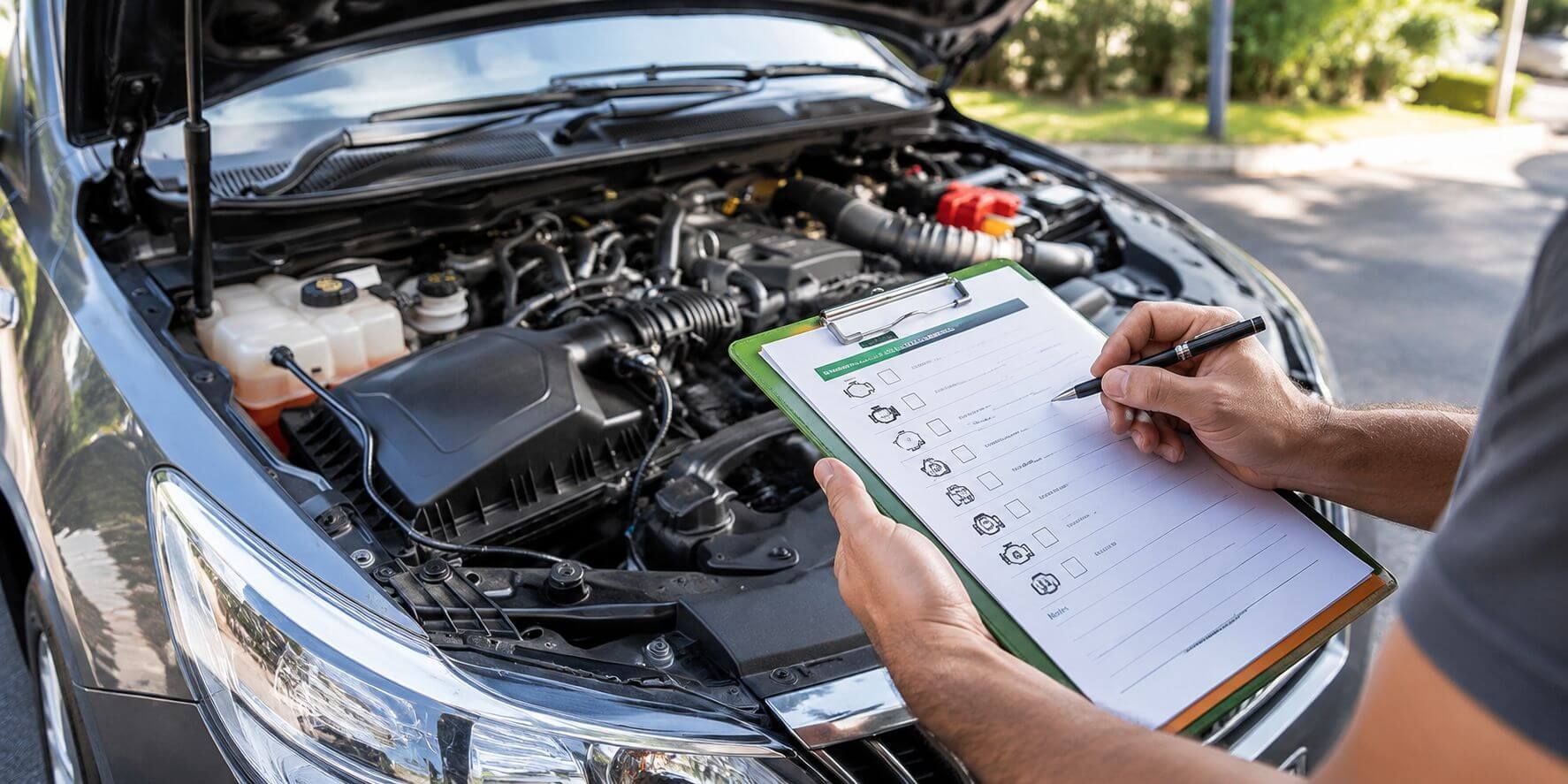
A used car may look impressive in photos and still have expensive problems that are difficult to spot during a short visit. A pre-purchase inspection helps you assess its condition, investigate warning signs, and decide whether the asking price reflects the risks involved.
A smart buying process combines three things: a vehicle history report, a careful inspection, and verification of the seller's paperwork. Each answers different questions. A VIN report may reveal available title brands, odometer entries, or reported accidents, but it cannot determine whether a vehicle is mechanically sound today.
The Federal Trade Commission (FTC) recommends an independent mechanic inspection even when a dealer has already inspected or certified the car.
Used Car Inspection Checklist: Quick Answer
Before agreeing to buy a used vehicle:
- Match the VIN on the car to its title and other documents.
- Review a vehicle history report for available title, mileage, accident, and salvage information.
- Inspect the exterior, tires, cabin, engine compartment, and underside for visible warning signs.
- Compare the displayed mileage with historical odometer entries and the car's wear.
- Check for flood damage and test the car's electrical features.
- Take a safe test drive, if permitted, and note steering, braking, transmission, and warning-light problems.
- Check for open recalls through NHTSA.
- Get an independent mechanic's written assessment before paying or signing a final agreement.
Use the checklist to identify questions for the seller and the mechanic. It is not a substitute for a professional inspection.
1. Verify the VIN, Title, and Seller's Paperwork
Start with the vehicle's identity. For most passenger cars built for the U.S. market since model year 1981, the VIN is a 17-character identifier. It is commonly visible at the base of the windshield on the driver's side and on a label near the driver's door opening.
Compare the VIN on the vehicle with the title, registration, and any sales paperwork. Confirm the year, make, and model. If a number is damaged, altered, or inconsistent, ask for an explanation and supporting evidence before proceeding.
Also check whether the title names the person or business authorized to sell the vehicle. If there is an outstanding lien, find out what documents and payoff arrangements are needed to transfer clear title. Procedures vary by state.
At a dealership, ask to see the FTC-required Buyers Guide. It explains whether the vehicle is offered with a dealer warranty or, where permitted, on an "as is" basis. Ask for any promises or negotiated conditions in writing. See the FTC's used-car buying guidance.
2. Run a VIN Check Before Inspecting the Car
A VinAudit vehicle history check can help you research available records associated with the VIN. Depending on the vehicle and reporting sources, a report may include:
- Title brands, such as salvage, rebuilt, or flood designations.
- Historical odometer readings that could indicate a mileage discrepancy.
- Reported accident and damage information, where available.
- Salvage or total-loss indicators, where reported.
- Other available vehicle-history entries, subject to coverage limits.
No vehicle history database contains every incident. A report without a matching accident entry is not proof that the car was never damaged, and historical mileage entries cannot certify the odometer's actual reading. Use the results to guide your questions and inspection, not to replace them.
Pay particular attention to dates, changes in title jurisdiction, unexplained mileage reversals, and discrepancies between the report and the seller's documents.
3. Inspect the Body, Paint, Glass, and Underside
View the car in good daylight, ideally when it is clean and dry. Walk around it slowly and look for:
- Uneven gaps around the doors, hood, trunk, or fenders.
- Paint color or texture differences between adjoining panels.
- Ripples, overspray, or uneven finishes that may suggest previous bodywork.
- Cracked glass, damaged lights, or moisture inside lamp housings.
- Corrosion, unusual rust, or damage visible underneath the vehicle.
Cosmetic repairs are not automatically disqualifying. The key is whether the seller's explanation matches what you see and whether a qualified inspector finds structural or safety concerns.
Do not crawl under an unsupported vehicle. Ask the mechanic to inspect the frame or unibody, suspension mounting points, and underside using appropriate equipment.
4. Check Tires, Wheels, Steering, and Brakes
Tires can reveal potential safety issues and help explain how the car has been used. Look for uneven tread wear, bulges, cracks, visible damage, and incompatible tire sizes. Check the tire age and condition, not just the tread depth.
Uneven wear can be associated with inflation, alignment, steering, or suspension problems, but it does not identify the cause by itself. A newer set of tires also does not prove high mileage or odometer fraud; tires can be replaced because of age, punctures, or damage.
Look through the wheels for obvious brake concerns, and note any brake warning lights. Have a mechanic evaluate brake pads, rotors, hydraulic components, and tire suitability rather than judging safety from appearances alone.
5. Compare the Odometer With the Vehicle's History
The dashboard mileage is a starting point, not independent verification. Review the available dated odometer entries in the vehicle history report and on the title, and compare them with the current reading.
For example, a record showing 82,000 miles in 2024 followed by 61,000 miles in 2026 needs an explanation. It could reflect an incorrect entry, a replaced instrument cluster, or possible tampering. The discrepancy alone does not prove fraud.
Check whether the vehicle's interior wear seems plausible for its claimed usage, particularly the seats, steering wheel, and pedals. Physical wear is a supporting clue, not an accurate mileage meter.
The National Highway Traffic Safety Administration (NHTSA) recommends checking mileage against title information, available records, and wear indicators. If the numbers conflict, ask for documentary clarification and consider walking away until the issue is resolved.
6. Look for Signs of Flood or Water Damage
Flood exposure can cause hidden corrosion and electrical faults that become apparent long after the vehicle has dried out. During your inspection, check for:
- Musty odors or unusually strong air fresheners.
- Mud, silt, or waterlines in the trunk, spare-tire well, or under seats.
- Corrosion on seat hardware, connectors, or other unusually sheltered metal surfaces.
- Damp carpeting, discolored upholstery, or inconsistent interior materials.
- Intermittent electrical problems or warning messages.
These signs warrant investigation, but none proves a vehicle was flooded. NHTSA advises buyers to examine hidden areas for grime, watermarks, and unusual rust. Its flood-damaged vehicle guidance also explains why flood history can be difficult to detect.
A title without a flood brand does not guarantee that the vehicle has avoided water damage. If you find suspicious clues, request a professional inspection with particular attention to wiring and corrosion.
7. Check Fluids, Leaks, Belts, and the Engine Bay
With the engine switched off and the vehicle parked safely, look for visible fluid leaks, damaged hoses, cracked belts, corrosion around accessible battery connections, and unsecured or improvised components.
Check accessible fluid levels only as instructed in the owner's manual. Do not open a hot cooling system, touch moving parts, or remove sealed electrical covers. Many modern vehicles have components that require a trained technician to inspect safely.
An unusually clean engine compartment is not proof of good condition, just as light dirt does not establish neglect. What matters is whether you see warning signs that deserve further diagnosis.
For hybrids and electric vehicles, leave high-voltage components and battery-system evaluation to a qualified specialist.
8. Check the Engine Startup, Dashboard, and Cabin Features
If possible, observe a cold start. Listen for persistent knocking, rough running, or unusual noises. Watch the dashboard indicator sequence and note warning lights that remain on after the system has started normally.
Test the air conditioning, heat, windows, locks, mirrors, wipers, lighting, audio, charging ports, seat functions, parking sensors, and cameras where equipped. Check that safety systems do not show unresolved warning messages.
A cleared warning light is not proof that a fault has been fixed. Ask an independent mechanic to scan relevant electronic modules and explain any diagnostic findings. Avoid improvised engine stress tests or other procedures that could damage the vehicle.
9. Take a Safe, Representative Test Drive
Only drive with the seller's permission and after confirming that the vehicle is legally operable and properly insured for the trip. Choose a route that includes ordinary city speeds and, where practical, a variety of road surfaces.
During the drive, pay attention to:
- Steering: Does the vehicle track predictably without excessive pulling or vibration?
- Braking: Does it slow smoothly without unusual noises, pulsation, or a warning light?
- Transmission: Are gear changes smooth and appropriate for the vehicle?
- Engine or motor: Does acceleration feel consistent, without hesitation or unusual sounds?
- Ride: Are there clunks, harsh vibrations, or noises over moderate bumps?
- Cabin functions: Do the climate controls and other features work while driving?
A test drive can reveal symptoms, but a smooth drive does not rule out hidden defects. Avoid unsafe maneuvers or aggressive tests to force a problem to appear.
10. Check Open Safety Recalls Using an Official Tool
Before purchase, visit NHTSA's free recall lookup and search by VIN. Its supported license plate search can also identify certain unrepaired recalls.
A result showing no unrepaired recalls has limits. NHTSA explains that its VIN and plate searches may not display completed recalls, some newly announced recalls, recalls older than 15 years, or certain smaller-manufacturer campaigns. If you have questions, contact an authorized dealer or the manufacturer.
A recall result is not a mechanical inspection, and it should not be assumed to establish the condition of the affected part.
11. Hire an Independent Mechanic Before You Commit
This is one of the most valuable steps in the buying process. Ask a qualified mechanic who is not involved in the sale to inspect the vehicle, ideally on a lift and with suitable diagnostic equipment.
Depending on the vehicle, the inspection should address the braking and steering systems, suspension, fluid leaks, underbody damage, drivetrain, electronic faults, and other model-specific concerns. For EVs or hybrids, select a shop with appropriate expertise.
Ask for a written inspection report identifying the vehicle and VIN, the findings, and estimated costs for necessary work. The FTC advises buyers to request this written assessment and use it when evaluating the purchase price.
If a seller refuses to allow any reasonable independent inspection, consider another vehicle. A dealer's own inspection or certification does not replace a separate evaluation.
12. Make the Final Decision Using Evidence, Not Appearance
Before paying, bring the findings together:
| What you checked | What it can tell you | What it cannot prove |
|---|---|---|
| VIN and title documents | Whether identifying details match and whether title questions need investigation | Current condition or an unrestricted right to sell without further verification |
| Vehicle history report | Available title, odometer, salvage, and reported incident entries | Every event in the vehicle's past |
| Visual inspection and test drive | Visible wear, warning lights, unusual behavior, or possible damage | The absence of hidden mechanical defects |
| Official recall lookup | Certain unrepaired safety recalls within the tool's coverage | That all safety-related problems are resolved |
| Independent mechanic inspection | Current findings and likely near-term work | A guarantee against future failures |
If issues appear, request clarification, estimate the cost, and decide whether the asking price still makes sense. Do not let urgency or a seemingly attractive deal replace reasonable verification.
Frequently Asked Questions
Is a vehicle history report enough before buying a used car?
No. It can help identify available historical warning signs, but it does not establish the car's current mechanical condition. The FTC recommends an independent inspection in addition to a vehicle history report.
What should I check first when inspecting a used car?
Start by verifying the VIN, title, and seller's authority to transfer the vehicle. Next, review available vehicle history information and inspect the body, tires, interior, and visible mechanical components.
How do I spot possible odometer rollback?
Compare the displayed mileage with dated mileage entries, title information, and physical wear. A backward reading or unexplained inconsistency is a reason to investigate, but it is not automatically proof of fraud. See our odometer fraud guide.
What are common warning signs of flood damage?
Musty odors, hidden mud, watermarks, abnormal corrosion, damp carpeting, and intermittent electrical problems deserve closer examination. A professional inspection is important because some water-related damage may not be visible immediately.
Can I inspect a used car myself instead of hiring a mechanic?
You can identify obvious concerns with a careful walkaround and test drive, but a qualified mechanic can assess components and faults that require tools, a lift, or specialized knowledge.
Can I check safety recalls for free?
Yes. Use NHTSA's official recall search. Its VIN and supported plate searches can identify certain open recalls, subject to the site's published coverage limitations.
Final Takeaway
A good used-car pre-purchase inspection is about reducing uncertainty, not finding a flawless vehicle. Verify the identity and title, review available history, examine the car, check recalls, and get an independent mechanic's assessment.
The strongest purchase decision comes from information that agrees across multiple sources. If the report, paperwork, seller's explanation, and physical inspection do not line up, resolve the discrepancy before committing.
Official consumer resources: FTC used-car buying guide · NHTSA odometer fraud guidance · NHTSA flood-damage guidance · NHTSA recall lookup