

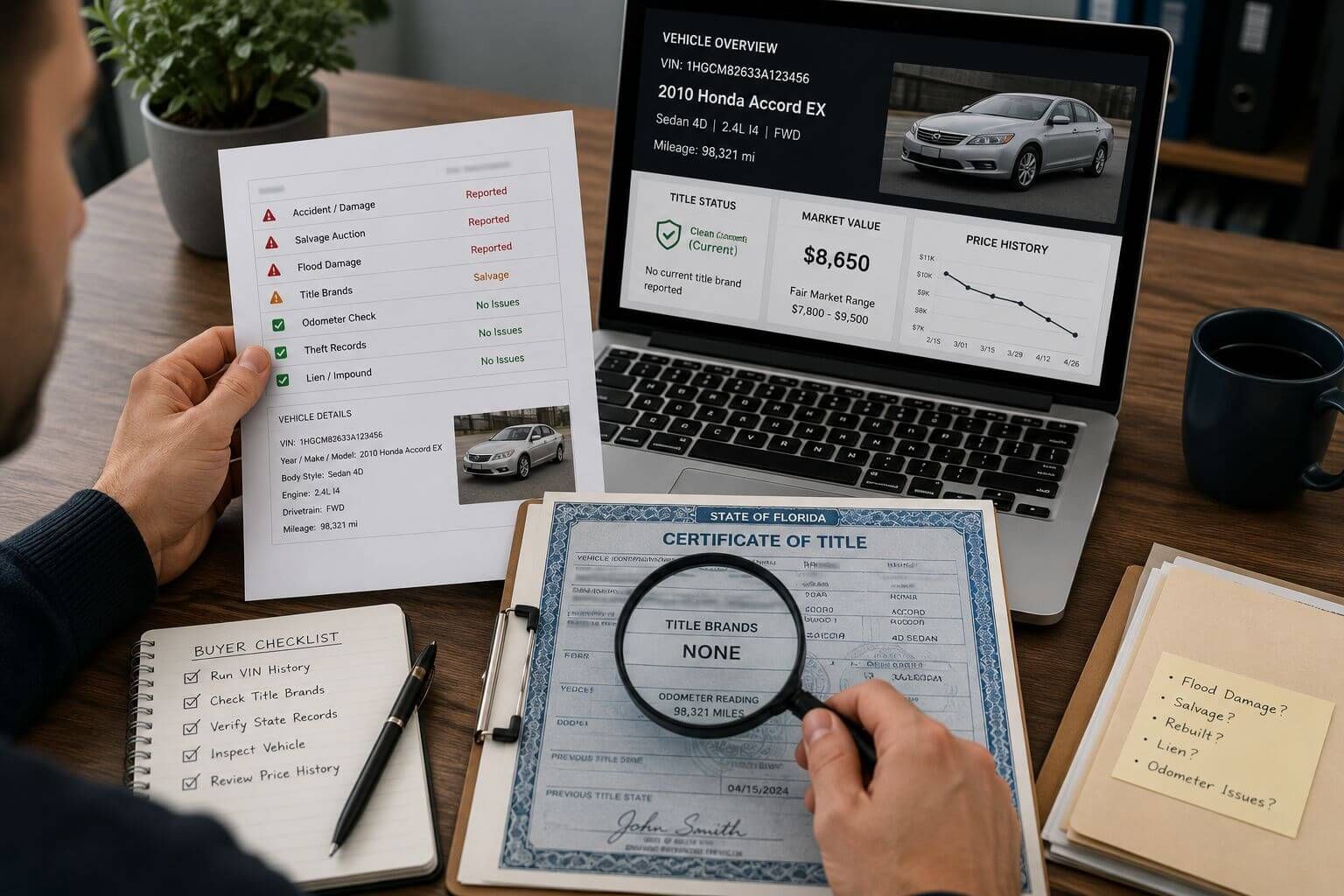
A used car can look clean on paper and still have a hidden past.
That is the danger of title washing. It happens when a vehicle’s prior title brand, such as flood, salvage, junk, or rebuilt, is hidden, removed, missed, or not carried forward clearly when the vehicle is retitled. To a buyer, the current title may appear clean. But the vehicle’s full history may tell a different story.
This matters because flood and salvage vehicles can carry serious risks. Electrical problems, structural repairs, airbag concerns, corrosion, mold, and resale limitations may not be obvious during a short test drive. If the title history is incomplete or misleading, a buyer may overpay for a vehicle that is worth much less than expected.
Before buying any used car, especially one that recently moved across states, run a title check by VIN and compare the title record with the seller’s documents.
What Is Title Washing?
Title washing is the process or result of making a vehicle’s title history look cleaner than it really is. In many cases, it involves a car that previously had a serious brand, such as salvage or flood, later appearing with paperwork that does not clearly show that brand.
This can happen because title rules, brand definitions, and reporting practices vary by state. It can also happen through fraud, incomplete records, or gaps in how past title information is carried forward.
For example, a car may be branded flood in one state after storm damage. Later, it may be moved, repaired, retitled, and sold somewhere else. If the prior flood brand does not appear clearly on the current paper title, a buyer may believe the vehicle has a clean history.
That is why the current title alone is not always enough.
Why Flood and Salvage Cars Are Commonly Involved
Flood and salvage vehicles are often connected to title washing because their value can change dramatically once the brand is known.
A salvage title usually means the vehicle was declared a total loss or suffered serious damage. A flood brand means the vehicle was damaged by water. Both can make the vehicle harder to insure, finance, register, or resell. They can also lower the vehicle’s market value.
A dishonest seller has a strong financial incentive to hide those brands. A car with a clean title may sell for much more than the same car with a disclosed flood or salvage history.
For buyers, that difference can be expensive. You may think you are paying for a clean-history vehicle when you are actually buying a damaged car with hidden risk.
How Title Washing Can Happen
Title washing can happen in several ways, but the main issue is usually the same: the vehicle’s paper trail becomes incomplete or misleading.
Common situations include:
- A branded vehicle is moved to another state.
- A state applies different branding rules or terminology.
- The current paper title does not show all prior brands.
- A seller relies only on the latest title and ignores older records.
- The vehicle is repaired cosmetically and marketed as clean.
- A buyer checks only the title document, not the VIN history.
- The seller avoids sharing records from prior states.
This is why a title check should look beyond the current title. It should consider title activity across states, brands, salvage or junk records, odometer records, theft records, and other vehicle history signals.
Why State Differences Matter
Vehicle title rules are not identical across the United States. States may use different brand names, apply different damage thresholds, and maintain different processes for recording or transferring title information.
That creates room for confusion. A vehicle that is clearly branded in one state may not be described the same way elsewhere. A flood-damaged vehicle may be flagged in one jurisdiction but not appear the same way in another. A rebuilt vehicle may need certain inspections in one state but different paperwork in another.
For buyers, the lesson is simple: do not assume that a clean-looking title means the entire history is clean. A title is a legal document, but it may not show every important event in the vehicle’s past.
When the history is unclear, use VinAudit’s state vehicle records guide to find official DMV or motor vehicle agency instructions for requesting state-level records.
Flood-Damage Risk: Why Florida Vehicles Deserve Extra Attention
Florida has a large used car market and regular exposure to hurricanes, heavy rain, and flooding. Not every Florida vehicle is risky, but buyers should be careful when a car has spent time in flood-prone areas or appears on the market after major storms.
A Florida license plate lookup can help buyers start checking vehicle details when they have a plate number but not yet the VIN. This can be useful in early-stage shopping, especially when a listing shows a Florida plate or the seller says the vehicle came from Florida.
Be cautious if a Florida vehicle has:
- A very low price compared with similar vehicles
- A recent out-of-state title transfer
- Musty odors or heavy air freshener smell
- New carpet or upholstery in an older car
- Electrical glitches
- Corrosion under seats, in the trunk, or around connectors
- Foggy lights or moisture in the instrument cluster
- Inconsistent service or registration history
Flood damage can be hard to detect because a vehicle may be cleaned and detailed before sale. A history check and inspection are both important.
Flood and Salvage Risk in Texas Vehicles
Texas also has coastal and flood-prone regions, along with a large vehicle market. As with Florida, the point is not to distrust every Texas vehicle. The point is to verify the record when the car’s title history, location history, or price raises questions.
A Texas license plate lookup can help connect a Texas plate to vehicle history details when the VIN is not available yet. This is especially helpful if you are looking at a private-party listing, auction listing, or marketplace ad where the seller has not clearly provided the VIN.
Pay extra attention if:
- The vehicle was recently titled outside Texas after being listed in Texas.
- The seller cannot explain where the car was previously registered.
- The price is unusually low for the model and mileage.
- The vehicle has signs of water exposure.
- The title is recently issued but the car is older.
- The seller avoids questions about flood, salvage, or insurance history.
A plate lookup is not a substitute for a full VIN-based report, but it can be a useful first check.
Warning Signs of Possible Title Washing
Title washing is not always obvious, but there are warning signs.
Watch for:
- Current title looks clean, but vehicle history shows prior brands.
- The vehicle moved between states recently.
- Seller cannot explain prior registration history.
- Title was issued recently for an older vehicle.
- Price is far below market value.
- The vehicle has signs of flood or major repair.
- VIN report shows salvage, junk, or auction records.
- Odometer readings do not line up.
- Seller discourages a third-party inspection.
- Title, registration, plate, and VIN details do not match.
- Seller says “clean title” but avoids providing documentation.
One red flag may have an innocent explanation. Several red flags together should make you pause.
What to Check Before Buying
If you suspect possible title washing, slow down and verify the vehicle from multiple angles.
Start with these steps:
- Get the VIN directly from the vehicle, not just the listing.
- Compare the VIN on the dashboard, door jamb, title, and registration.
- Run a title check by VIN.
- Review prior title brands, registration history, salvage records, and odometer records.
- Check whether the vehicle was titled in flood-prone or storm-affected states.
- Use plate lookup if the seller provides a plate before the VIN.
- Ask for service records, repair invoices, and title documentation.
- Request state vehicle records when the history is unclear.
- Get an independent inspection from a qualified mechanic or body shop.
- Walk away if the seller refuses normal verification.
The goal is not to prove fraud by yourself. The goal is to avoid buying a vehicle when the story does not make sense.
How a VIN Check Helps Uncover Hidden History
A VIN check can help reveal information that may not appear clearly on the current paper title. This may include title history, title brands, theft records, salvage or rebuild records, prior sale listings, odometer records, and open lien indicators.
This is important because title washing often depends on the buyer looking only at the latest paperwork. A VIN-based history review can give you a broader view of the vehicle’s past.
If the VIN report shows a prior flood, salvage, junk, or rebuilt record, do not ignore it just because the seller says the current title is clean. Ask for documentation and verify with the appropriate state agency if needed.
What an Inspection Should Look For
A mechanic or body shop inspection is especially important for flood and salvage vehicles.
For flood risk, ask the inspector to check:
- Wiring and electrical connectors
- Under-seat metal parts
- Trunk and spare tire well
- Carpets and insulation
- Dashboard electronics
- Airbag systems
- Lights and sensors
- Corrosion in unusual places
- Mold or moisture smell
For salvage or prior collision risk, ask about:
- Frame or structural repairs
- Airbag replacement
- Paint inconsistencies
- Panel gaps
- Suspension damage
- Weld marks
- Non-original parts
- Poor repair quality
- Warning lights or diagnostic codes
A clean test drive is not enough. Flood and structural problems can appear later.
Should You Ever Buy a Washed-Title Vehicle?
If a vehicle’s title history looks washed or misleading, be very careful. In many cases, the safest move is to walk away.
You might still consider a branded or previously damaged vehicle if everything is fully disclosed, the price reflects the risk, repairs are documented, the inspection is strong, and your insurer and state DMV confirm that registration will not be a problem.
But a vehicle with unclear, hidden, or inconsistent title history is different. If the seller is not transparent, the risk is much higher.
A good deal should still make sense after the title check, inspection, and paperwork review. If it only looks good when you ignore the history, it is not a good deal.
Final Takeaway
Title washing can make flood and salvage vehicles look cleaner than they really are. That creates real risk for used car buyers, especially when a vehicle has moved between states, appears after major storms, or is priced far below similar listings.
Do not rely only on the current paper title. Check the VIN, compare the documents, review title history, use plate lookup when helpful, verify state records, and get an independent inspection.
A few extra checks before buying can protect you from hidden damage, registration problems, insurance issues, and paying clean-title money for a vehicle with a damaged past.
FAQs
What is title washing?
Title washing happens when a vehicle’s prior title brand, such as flood, salvage, junk, or rebuilt, is hidden, removed, missed, or not clearly carried forward when the vehicle is retitled.
How can a salvage car get a clean title?
A salvage car may appear with cleaner paperwork if it is retitled in another state, if prior brands are not carried forward clearly, or if records are incomplete or manipulated. That is why buyers should check the VIN history, not just the current title.
How do I know if a car has flood history?
Run a title check by VIN, review prior state registrations, look for flood or salvage records, inspect for water-damage signs, and have a qualified mechanic check electrical systems, carpets, connectors, and hidden corrosion.
Is a clean title always safe?
No. A clean title does not guarantee a clean history. A vehicle may still have accident records, flood exposure, odometer issues, salvage auction history, or prior title brands that do not appear clearly on the current paper title.
What should I do if I suspect title washing?
Stop the purchase until you verify the vehicle. Run a VIN check, compare documents, request state records, get an independent inspection, and avoid sellers who refuse normal verification.