US
US CA
CA
Check a Colorado Plate Before You Buy
Enter a Colorado license plate number to search for a matching vehicle and check whether vehicle-history information is available. An initial search may identify basic vehicle details or a possible plate-to-vehicle match. Access to the complete VinAudit vehicle history report, when available, requires following the report-order process.
Colorado recorded 5,276,703 registered motor vehicles in the Federal Highway Administration’s 2024 data. With active used-car markets in Denver, Colorado Springs, Aurora, and communities throughout the state, checking a vehicle’s background can help buyers assess a listing before completing a purchase.
A license plate search may connect the plate number with the vehicle identification number associated with available records. The result depends on the accuracy, coverage, and recency of the source data, so a plate may not always produce a match. When the VIN is visible on the vehicle or its documents, you can also use VinAudit’s VIN check.
Information You May Find in the Report
A successful plate search can lead to available vehicle-history records connected with the matched vehicle. The exact information varies by vehicle and reporting source.
- Vehicle Specifications: Basic identifying information such as model year, make, model, body type, engine details, and other available specifications.
- Title History: Reported title events, title brands, and state title records that may indicate salvage, rebuilt, flood, junk, or other significant status.
- Accident and Damage Records: Available accident, insurance, structural-damage, or damage-related records reported by participating sources.
- Odometer Information: Reported mileage readings and possible inconsistencies that may warrant closer inspection.
- Theft and Recovery Records: Available records indicating whether the vehicle has been reported stolen or recovered.
- Sale and Market Information: Historical listings, auction information, and available market-value or ownership-cost tools.
Coverage is not identical for every vehicle, and a report should complement—not replace—a physical inspection, test drive, title review, and professional mechanical evaluation. See the VinAudit report sections for more information about potentially available data.
How Plate-to-Vehicle Matching Works
The search begins with the plate number and its state of registration. From there, the system checks available records for a vehicle match and, when supported, connects the plate to the VIN used for the vehicle history search.
- Enter the Plate Number. Type the plate as it appears on the vehicle, without adding unnecessary spaces or symbols.
- Select Colorado. The same plate characters may exist in more than one state, so the registration state is needed for matching.
- Review the Initial Result. The search may display basic vehicle information or indicate whether a matching vehicle was found.
- Open the Complete Report. Follow the checkout instructions to access the paid vehicle history report when one is available.
- Verify the Vehicle. Compare the returned year, make, model, and VIN with the vehicle, title, registration, and seller-provided documents.
A failed or incorrect match does not automatically mean the plate is invalid. It may have been entered incorrectly, recently issued, transferred under an eligible exception, replaced, associated with a specialized plate type, or not yet reflected in the available data.
License Plates and Registration in Colorado
The Colorado Division of Motor Vehicles, part of the Department of Revenue, administers statewide motor vehicle programs, while county motor vehicle offices handle many title, registration, and license plate transactions. Official services should be used for registration renewal, plate replacement, title transactions, and authorized vehicle-record requests.
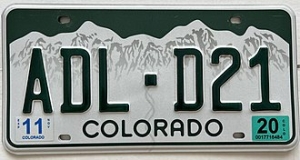
| Issuing Agency | The Colorado Division of Motor Vehicles (DMV) oversees statewide programs, while county offices handle many title, registration, and plate transactions. |
| General-Issue Plate | Colorado offers standard passenger plates along with personalized, specialty, military, disability, motorcycle, trailer, and other vehicle-specific plates. |
| Plate Display | Vehicles issued two plates generally display one at the front and one at the rear, while single-plate vehicles use a rear plate. |
| Registration Renewal | Eligible registrations may be renewed through myDMV, participating kiosks, mail, or a county motor vehicle office. |
| Renewal Requirements | Renewal may require current insurance, emissions compliance where applicable, payment of fees, and eligibility for the selected method. |
| Replacement Plates | Eligible replacement plates may be requested through myDMV or a county office, while stolen plates should also be reported. |
| Plate Transfer | Most standard plates expire when ownership changes, although certain personalized or qualifying plates may be transferable. |
| Official Vehicle Records | Authorized record and title-history requests require eligibility, documentation, fees, and compliance with privacy rules. |
For vehicles registered in nearby states, use the corresponding state lookup page:
VinAudit Vehicle History vs. Colorado DMV Services
VinAudit and the Colorado DMV serve different purposes. Choose the source based on whether you are researching a vehicle’s broader history or completing an official state transaction.
| VinAudit Vehicle History | Provides available title, accident, odometer, theft, salvage, sale, specification, and market information. |
| Colorado DMV Services | Handle official title, registration, plate, renewal, replacement, and authorized record transactions. |
| Personal Information | VinAudit does not provide an owner’s name, address, phone number, or other protected personal information. |
| Best Use | Use VinAudit for vehicle-history research and Colorado DMV services for official records and transactions. |
When a Plate-Based Vehicle Check Is Useful
A plate-based vehicle history search is especially useful when the VIN is not shown clearly in an advertisement or is not immediately available.
- Reviewing an Online Listing: Check whether the plate returns a vehicle that matches the seller’s stated year, make, and model.
- Preparing To Inspect a Used Car: Identify available title, accident, odometer, theft, or salvage information before an in-person visit.
- Comparing Multiple Vehicles: Use consistent history checks to screen several listings before narrowing your options.
- Checking Seller-Provided Information: Compare the result with the VIN, title, registration, maintenance records, and other documents.
- Evaluating a Trade-In or Private Sale: Review available history before agreeing on a price or completing a transaction.
Do not rely on a plate lookup to confirm legal ownership or determine whether the seller has authority to transfer the vehicle. Examine the original title and identification, confirm the VIN on the vehicle, and complete the appropriate Colorado title-transfer process.
Colorado Plate Lookup Questions
Is a Colorado license plate lookup free?
You can begin by entering the plate number and state to search for a possible vehicle match. The initial result may provide basic information or indicate whether a report is available. Access to the complete VinAudit vehicle history report is a paid service.
Can I find the owner of a Colorado license plate?
No. A public VinAudit lookup does not provide the registered owner’s name, home address, telephone number, or other protected personal information. Access to official motor vehicle records is restricted by federal and state privacy rules and may require a legally permitted purpose.
Can a Colorado plate number be used to find the VIN?
Sometimes. When available records support a reliable match, a plate number and registration state may be connected with the VIN associated with the vehicle. Matching is not guaranteed, especially for recently issued, replaced, transferred, specialized, or incorrectly entered plates.
What should I do if the plate returns the wrong vehicle?
Check the plate characters and confirm that Colorado was selected as the registration state. Similar characters such as zero and the letter O can be confused. Do not purchase a report when the displayed vehicle does not match the vehicle being researched; instead, obtain the VIN directly from the vehicle or its documents.
Does a VinAudit plate lookup replace a Colorado DMV record search?
No. VinAudit provides vehicle-history information for research and purchase decisions. Colorado DMV and county motor vehicle offices provide official title, registration, plate, renewal, replacement, and authorized record-search services.
What information should I verify before buying a used vehicle?
Compare the vehicle’s VIN with the title, registration, dashboard or windshield plate, and door-jamb label. Review the vehicle history, inspect the original title, arrange a mechanical inspection, confirm any lien information, and make sure the seller is authorized to transfer ownership.